Let's say the quiet part out loud: sex is supposed to feel good, and sometimes it just… doesn't. If you've ever gritted your teeth through a moment that was billed as toe-curling, welcome — you're in extremely good company. Nearly three in four women deal with painful intercourse at some point in their lives, according to the American College of Obstetricians and Gynecologists, which makes the thing nobody mentions at brunch basically a group activity.1
Simone Farschi, Sex and Intimacy Coach and founder of The Pleasure Plus, sees it constantly in her practice and opens with the same reassurance:
"Painful sex is way more common than most people admit." — Simone Farschi, Sex and Intimacy Coach
Here's what your body wishes you'd heard sooner: common doesn't mean normal, and it definitely doesn't mean permanent. Discomfort during sex is a signal, not a life sentence. Let's talk about why it shows up and what you can actually do about it.
Key Takeaways
- Pain during sex is incredibly common. Most women feel it at some point in their lives, so shame has no business here.
- Doctors sort it into two buckets: entry pain (right at the vaginal opening) and deep pain (further in, often position-dependent).
- Causes range from vaginal dryness and tight pelvic floor muscles to vaginal infections, endometriosis, and even irritable bowel syndrome.
- Emotional safety matters as much as anatomy. Bodies can generate pain when something doesn't feel right.
- Small tweaks — more warm-up, the right lube, gentler positions — can make a big difference.
- If pain is frequent or sharp, that's a chat-with-your-doctor situation, not a grin-and-bear-it one.
First, where does it actually hurt?
Two flavors, medically speaking. Entry pain shows up right at the vaginal opening, that first-hello moment. Deep pain lives further in and tends to flare in certain positions or with deeper thrusting.
Entry pain is usually a lubrication story. Not enough warm-up, a dip in estrogen after childbirth or during breastfeeding, or certain meds (antihistamines and some antidepressants, we're looking at you) can leave things drier than intended. Tight pelvic floor muscles, which quietly clench when you're stressed, are another usual suspect, along with vaginal infections and skin irritation.
Deep pain plays a longer game. It can be tied to endometriosis (where tissue grows where it shouldn't, sometimes near the fallopian tubes), fibroids, ovarian cysts, or a cranky gut situation like irritable bowel syndrome. Sexually transmitted infections can cause pain too, which is one more reason regular testing is simply good self-respect.
Simone's list from years of client work runs even longer:
"Many women have or have had cysts, fibroids, or scar tissue in the pelvic bowl, which can create tightness, sensitivity to penetration, and overall body changes that don't always feel sexy. Childbirth can also leave scar tissue. Conditions like MS and vaginismus can cause tightness and contraction in the vagina. Other common causes include recurring yeast infections, UTIs, and BV. A newer infection that is becoming more recognized, though not always easily detected, is ureaplasma and mycoplasma. These conditions are treatable, but they can feel extremely irritating, and no matter how badly someone might want to have sex, the sensations are telling the body no."
That last line deserves a re-read. Wanting sex and being able to comfortably have it are two different things, and your body gets a vote.
Your head is part of the equation
Anxiety, past experiences, and mental health talk directly to your body. When your brain braces, your muscles follow, and the whole thing gets less fun. That's not weakness; that's biology.
Simone puts it more directly: "Ask yourself if there is something emotional happening, because our bodies can create pain when they don't feel safe."
She's speaking from experience:
"I had this happen to me while I was having sex with someone I deeply wanted, but who ultimately wasn't emotionally available for me. My mind knew the relationship wasn't right, but the sex was good, and I kept pushing past my truth until my body spoke up and I had to listen. I needed time to get clear on what I wanted and needed emotionally, and I realized it wasn't with that person."
Techniques that actually help
Good news? A lot of discomfort responds to surprisingly simple adjustments.
Slow the whole thing down. Arousal isn't a switch, it's a dimmer. More foreplay means more natural lubrication and looser pelvic floor muscles, which means less friction and more "oh, there it is." Rushing is the enemy.
Get on top, literally. When you're the one steering, you control the depth and the angle instead of white-knuckling whatever's happening to you. Being on top or side-lying (spooned from behind) puts you in the driver's seat. And if deeper penetration is where the pain lives, shallower is your friend. Smaller movements, less depth, more of what actually feels good.
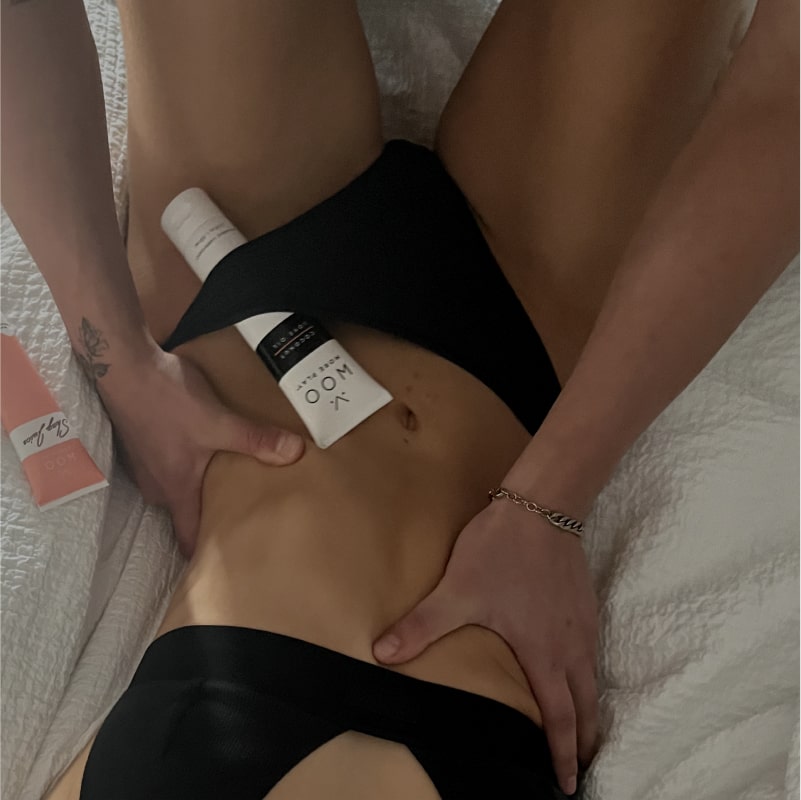
Lube like you mean it. Not a last resort — a headliner. A good glide cuts friction on contact and works wonders for vaginal dryness, and using it is a flex, not a confession. WOO's Love Oil is the go-to for condom-free nights, while Shag Juice steps in when condoms are in play or you want a gentle, hypoallergenic, water-based option.
Breathe and reset. If something pinches, pause. Powering through teaches your body to brace next time, which is how one rough night becomes a pattern. Simone is blunt about this: "It's important to talk about these symptoms when they arise and not try to push past them."
Wander off the beaten path. Penetration isn't the whole main event. Non-penetrative play keeps intimacy alive while you sort things out, zero pressure required. Simone recommends taking a deliberate break: "Take some time away from penetrative vaginal sex and explore other ways of connecting that are nourishing for the body. External vulva massage and using the right oils or moisturizers may help ease discomfort rather than inflame it."
When to actually call your doctor
A one-off twinge is probably fine. But if pain during sex is frequent, sharp, or coming with things like unusual discharge, bleeding, or burning, book the appointment. Recurring pain can point to something treatable: infections, hormonal shifts, chronic pain conditions, pelvic floor issues. Your OB-GYN has heard it all before. Prioritizing your sexual health is the opposite of dramatic. It's just smart.
Simone's home triage before you get there: "If you are experiencing pain and it's new, the first things to check are whether everything feels, looks, smells, and tastes normal. Pay attention to what is happening in your body."
And once you've got answers, you have more options than you might realize:
"It's best to talk with your gynecologist right away if you are experiencing any kind of pain. It's also worth getting tested for STIs and checking for cysts or other underlying causes. Once you know the cause, you can begin working with it at home and with professionals such as a pelvic floor physical therapist, sex coach, or sexological bodyworker."
Frequently Asked Questions
Is it normal for sex to hurt sometimes?
Occasional discomfort happens and usually isn't a red flag (think a dry moment or an awkward angle). But frequent or intense pain during sex isn't something to push through. It's your body flagging that something's worth a closer look.
Can stress really cause pain during sex?
Yes. Stress and mental health strain make your pelvic floor muscles tighten and lower arousal, which cuts natural lubrication. Less lubrication plus more tension equals more friction and discomfort. Slowing down and warming up genuinely helps here.
Does lube actually help with painful intercourse?
Often, yes, especially for entry pain and vaginal dryness. A quality water-based or silicone-based lubricant reduces friction right away and makes penetration smoother. It won't fix underlying conditions, but it removes one very common source of discomfort fast.
What positions reduce discomfort during sex?
Positions where you control depth and angle — being on top, or side-lying spooning — tend to help, especially for deep pain. Going shallower and slower eases pressure on sensitive spots. Adjust based on exactly where you feel it.
When should I see a doctor about pain during sex?
If pain is frequent, severe, or paired with bleeding, unusual discharge, or burning, make an appointment. These can signal infections, hormonal changes, or conditions like endometriosis, all far easier to treat once someone actually takes a look.
Final Thoughts On Discomfort During Sex
Here's the line worth tattooing somewhere tasteful: discomfort during sex is common, it's rarely permanent, and it is absolutely not a character flaw. Your pleasure is worth troubleshooting. Start with the easy stuff: slow down, lube up, switch positions. Loop in a doctor if the pain keeps crashing the party.
Simone's closing word on it says everything: "The most important thing to know about pain is that it is common, and it deserves attention. Don't hide it, and don't push through it. There are many paths to healing, and you deserve to receive that care."
Better sex tends to start with better information, and now you've got it. WOO's whole thing is helping you feel more at home in your own body, so consider this your permission slip to expect more from your sex life. You've earned it.
About The Expert

Simone Farschi, Sex and Intimacy Coach
Simone is the founder of The Pleasure Plus, an online community that brings women together to learn how to have fulfilling and emotionally intelligent relationships, be empowered and secure in their bodies, be authentically themselves, gain sexual agency, trust their choices, and communicate desires—becoming more magnetic, radiant, and fulfilled in all aspects of their lives.
She offers private coaching sessions, pleasure mentorships, online courses, and retreats, and most recently brings art to the zone of pleasure with handmade Vulva Castings, celebrating the body as a timeless beauty.
Sources:
1 - https://www.acog.org/womens-health/faqs/when-sex-is-painful